DAVESTORYTELLING LLP

Why Indian Companies Are Flooding in Dubai
Not because they are leaving India behind but because India Inc is finally going global.
DAVE DIVE
5/23/20264 min read
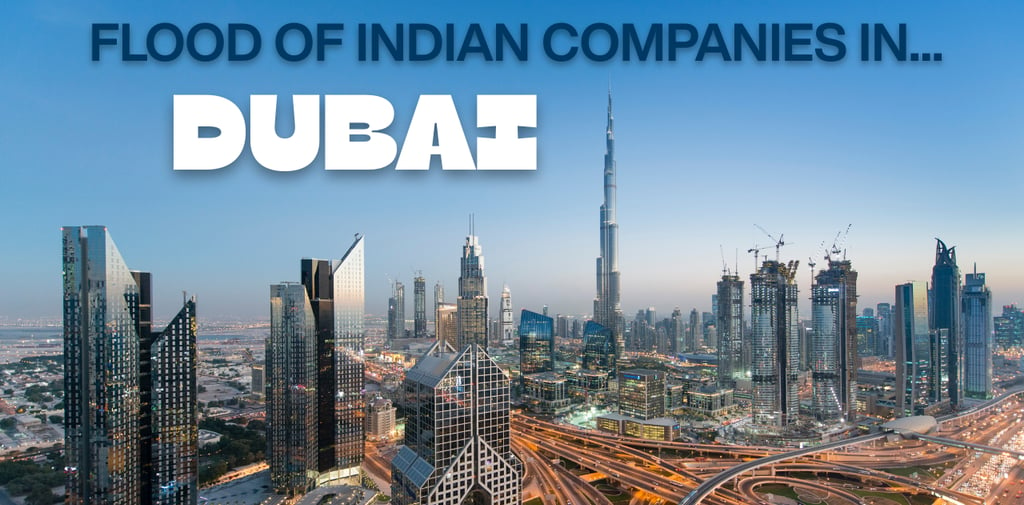
At Dubai International Airport, the accents sound increasingly familiar. Walk through a startup
conference in Downtown Dubai, a luxury jewellery exhibition near Deira, or a business networking event inside the Dubai International Financial Centre, and one thing becomes obvious: Indian business has arrived in force.
Not quietly. Not temporarily. And definitely not accidentally.
For decades, Dubai was seen mainly as a place where Indians worked. Construction workers,
shopkeepers, hotel staff, traders, and gold merchants formed the backbone of the city’s migrant
economy. But something profound has changed in the last few years.
Today, Indian entrepreneurs are not just working in Dubai but they are building companies there,
moving headquarters there, raising money there, and using the emirate as a launchpad for global expansion. From fintech startups and restaurant chains to billion-dollar family businesses and tech founders, Indian companies are flooding into Dubai at a pace that is reshaping both economies.
Dubai Is Becoming India Inc’s Global Shortcut
For Indian businesses, Dubai solves multiple problems at once. It offers global connectivity, easier regulations, international investors, lower taxes, world-class infrastructure, and access to markets stretching from Africa to Europe.
An entrepreneur sitting in Bengaluru or Mumbai can struggle with paperwork, logistics, and long
regulatory processes. In Dubai, many businesses can be set up in days. That speed matters.
The city functions almost like a giant commercial airport lounge for global capitalism: efficient,
polished, multilingual, and always open. Hindi is heard everywhere. Indian food dominates entire neighbourhoods. Bollywood celebrities own homes there. Indian schools educate thousands of families. Even grocery stores often stock the same brands found in Delhi or Ahmedabad.
The Great Post-Pandemic Shift
The real acceleration began after the pandemic. Remote work changed how entrepreneurs think
about location. Suddenly, founders no longer needed to remain tied to one city or country.
Dubai moved quickly to exploit this shift. It introduced long-term visas, expanded residency
options, promoted startup ecosystems, and aggressively marketed itself as the business capital
between East and West.
Indian entrepreneurs responded almost immediately. Wealthy founders began relocating family
offices. Startup founders opened regional headquarters. Influencers and creators moved for tax
reasons. Restaurant brands expanded into Dubai malls at lightning speed.
The Indian Brands You Now See Everywhere
What makes the trend visible is the growing presence of recognisable Indian brands across Dubai. Walk through malls or business districts and you’ll increasingly encounter names familiar to Indian consumers: Tata Group companies expanding hospitality and retail networks, Reliance Industries exploring Gulf retail and energy partnerships, Infosys and Tata Consultancy Services
strengthening Gulf technology operations, jewellery giants like Malabar Gold & Diamonds and
Joyalukkas dominating gold retail, and restaurant chains such as Bikanervala and Haldiram’s
attracting both Indian and international customers.
Even India’s startup ecosystem is becoming visible in Dubai. Companies linked to founders from
Zomato, OYO, and Paytm have explored or expanded Gulf-facing operations. In many ways, Dubai is becoming the first international showroom for Indian consumer brands.
The Tax Advantage Everyone Talks About
Of course, taxes remain one of the biggest attractions. Dubai’s low-tax environment is enormously appealing for Indian founders and wealthy individuals. But taxes alone do not explain Dubai’s rise. Many low-tax countries exist around the world. Few have managed to attract Indian business at this scale.
Dubai succeeded because it combined taxes with something equally important: convenience.
Flights between Indian cities and Dubai are frequent and relatively short. Time zones overlap
comfortably with India, Europe, and parts of Asia. English is widely spoken. Banking systems are internationally integrated. Infrastructure actually works.
Indian Startups Are Expanding Beyond India
A major trend emerging now is that Indian startups no longer want to remain “India-only”
companies. Many are using Dubai as their first international step. Fintech startups are targeting Gulf consumers. Edtech firms are entering expatriate markets. Health-tech companies are building Gulf partnerships. D2C brands are testing international demand through Dubai’s retail ecosystem.
Dubai also gives Indian companies credibility with global investors. A startup with a Dubai
presence suddenly appears more international, more export-oriented, and more scalable.
The Rise of the Indian Luxury Entrepreneur
Another fascinating shift is happening in luxury business. Indian luxury jewellers, fashion retailers, gourmet food brands, wellness companies, and premium real estate investors are expanding rapidly across the emirate. The reason is simple: Dubai has become one of the world’s biggest playgrounds for affluent consumers.
Bollywood, Influencers, and the New Indian Soft Power
Business expansion is also being driven by culture. Shah Rukh Khan, Salman Khan, and many
Bollywood celebrities frequently live, invest, or vacation in Dubai. Indian influencers constantly
showcase Dubai lifestyles on social media.
For millions of middle-class Indians, Dubai no longer feels like a distant foreign city. It feels
accessible. That emotional connection helps Indian brands expand more easily there than in many Western markets.
A New Financial Corridor Is Emerging
Increasingly, Dubai is becoming a bridge between Indian capital and global capital. Indian
entrepreneurs are raising funds there, setting up investment offices there, and networking with
international investors there. Family offices from India are also moving portions of wealth management operations to Dubai. In many ways, Dubai is positioning itself as the offshore financial capital for India’s wealthy class.
The Bigger Story
The deeper story here is not really about Dubai. It is about India itself. Indian companies are expanding because India’s economy has become too large, too ambitious, and too globally connected to remain domestically focused.
A new generation of Indian entrepreneurs thinks internationally from day one. And among all
global cities competing for their attention, Dubai has positioned itself perfectly: close enough to
India, connected enough to the world, and flexible enough for modern business.
That is why Indian companies are flooding into Dubai. Not because they are leaving India behind but because India Inc is finally going global.